Active Recall: The #1 Study Technique for Vocabulary Mastery
Stop re-reading word lists. Active recall is the most effective learning technique backed by 100+ years of research. Learn how to implement it today and remember vocabulary 2-3x better than passive study methods.
Jan 27, 2026
The Problem With How Most People Study
Open a vocabulary list. Read through the words. Read them again. Highlight some. Feel like you're learning. Take a test. Forget everything.
Sound familiar?
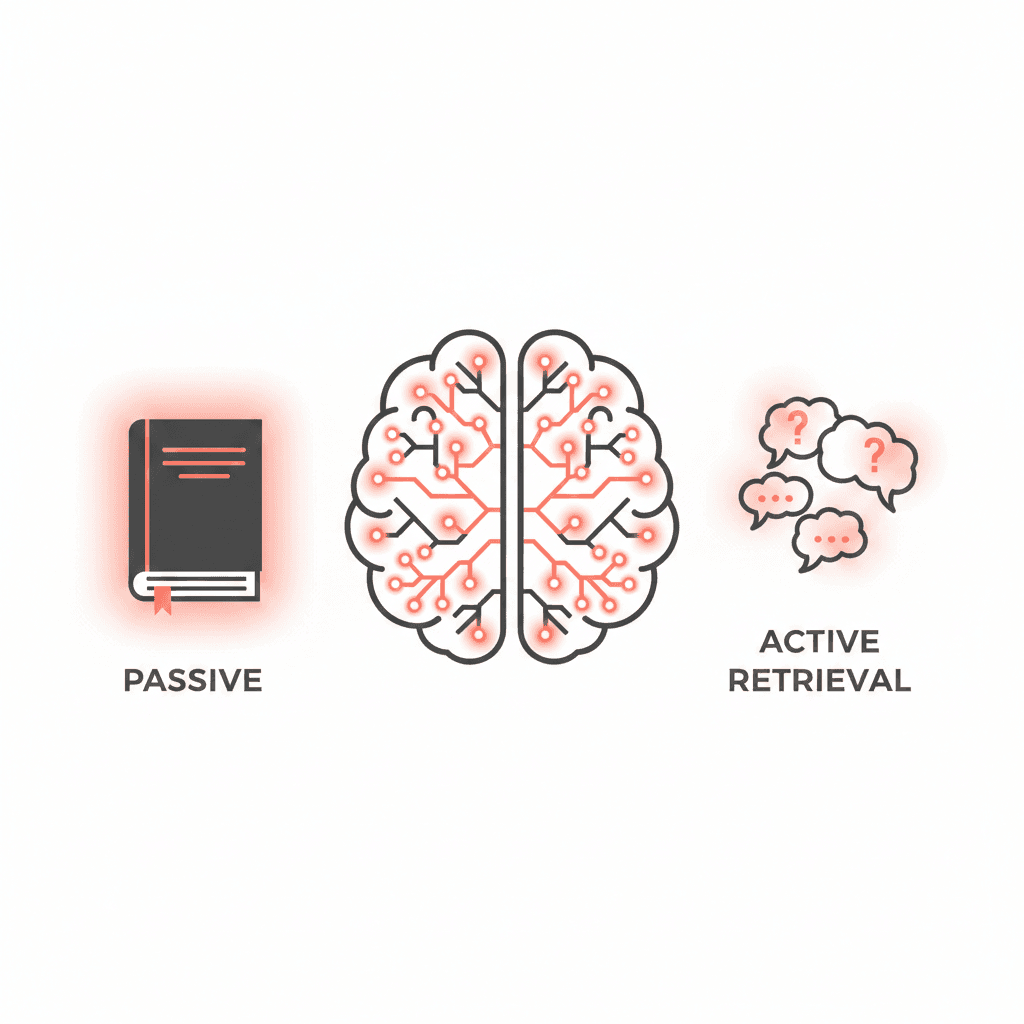
This is passive learning, and it's how most people study vocabulary. It feels productive because you're spending time with the material. But reading and re-reading creates an illusion of competence without actual learning.
There's a better way. It's called active recall, and research spanning over a century proves it's the most effective learning technique ever discovered.
What Is Active Recall?
Active recall is simple: instead of reviewing information by looking at it, you retrieve it from memory.
Passive study: Look at "negotiate" → Read "to discuss to reach an agreement"
Active recall: See "negotiate" → Cover the definition → Try to remember it → Check if you're right
The key difference? You're forcing your brain to work. That mental effort is exactly what creates strong, lasting memories.
The Science Behind It
The Testing Effect
In 2008, researchers Karpicke and Roediger conducted a landmark study. Students learned Swahili vocabulary using different methods:
- Group 1: Studied all words, tested on all words (repeated)
- Group 2: Studied all words, tested only on words they hadn't recalled yet
- Group 3: Studied only words they hadn't recalled, tested on all words
- Group 4: Studied only words they hadn't recalled, tested only on those
One week later:
| Group | Final Test Score |
|---|---|
| Group 1 | 80% |
| Group 2 | 36% |
| Group 3 | 80% |
| Group 4 | 33% |
The stunning finding: continued testing (Groups 1 and 3) doubled retention compared to continued studying (Groups 2 and 4). Testing isn't just assessment—it's learning.
Why Retrieval Strengthens Memory
When you retrieve information, three things happen:
- Neural pathways strengthen: Successfully recalling a word reinforces the connections in your brain
- Retrieval cues multiply: Each recall attempt creates new mental pathways to the information
- Weak memories are identified: Failed recalls show exactly what needs more work
Re-reading does none of these. You recognize the word, feel familiar with it, but build no retrieval strength.
Active Recall vs. Passive Study
| Aspect | Passive Study | Active Recall |
|---|---|---|
| Mental effort | Low | High |
| Feels like | Easy, comfortable | Challenging, sometimes frustrating |
| Recognition | Builds recognition | Builds actual recall |
| Long-term retention | 20-40% | 60-80% |
| Identifies weak spots | No | Yes |
| Time efficiency | Low | High |
The uncomfortable truth: if studying feels too easy, it's probably not working.
How to Implement Active Recall
Method 1: Cover and Retrieve
The simplest technique:
- Look at the vocabulary word
- Cover the definition
- Try to recall the meaning
- Check your answer
- If wrong, study briefly and try again
Pro tip: Wait a few seconds before checking. That slight struggle is where learning happens.
Method 2: Flashcards (Done Right)
Flashcards are active recall tools—but only if used correctly.
Wrong way:
- Flip card, read both sides
- "I knew that" → move on
- Passive recognition disguised as learning
Right way:
- See the prompt (word or definition)
- Attempt to recall before flipping
- Mark cards as "know" or "don't know" honestly
- Review "don't know" cards more frequently
Method 3: Blank Sheet Method
For comprehensive review:
- Close your vocabulary materials
- Write down every word you can remember from memory
- Try to write definitions for each
- Open your materials and check
- Note what you missed
- Focus future study on gaps
This method reveals exactly what you truly know versus what you think you know.
Method 4: Self-Quizzing
Create mini-tests for yourself:
- Write 10 definitions, match to words
- Fill in the blank sentences
- Multiple choice with similar-looking options
- Oral quizzing (say definitions aloud)
The format matters less than the retrieval attempt.
The Struggle Is the Point
Here's what trips people up: active recall feels harder than passive study. You'll forget words. You'll feel frustrated. You'll think "I'm not learning anything."
This is wrong. The difficulty is the learning.
Research calls this "desirable difficulty." When retrieval is slightly challenging:
- You engage more deeply
- Memory traces strengthen more
- Retention improves dramatically
If you can recall something effortlessly, you're not learning—you already know it. The words at the edge of your memory, the ones that require effort to retrieve, those are where growth happens.
Combining Active Recall With Spaced Repetition
Active recall tells you how to study. Spaced repetition tells you when to study.
Together, they're unstoppable:
- Learn new words using active recall (not passive reading)
- Review at increasing intervals using active recall
- Each review is a retrieval attempt, not a re-read
- Words you struggle with get reviewed sooner
- Words you recall easily get reviewed later
This combination can make learning 2-3x more efficient than traditional methods.
Common Mistakes to Avoid
1. Checking Too Quickly
Resist the urge to flip the card immediately. Give yourself 5-10 seconds to struggle. If you can't recall, that's valuable information.
2. Rating Yourself Too Generously
"I kind of knew that" is not knowing it. Be honest. If you didn't recall it clearly and correctly, mark it as missed.
3. Only Using Recognition
Seeing a word and thinking "yes, I know this one" without actually recalling the definition isn't active recall. Force yourself to produce the answer, not just recognize it.
4. Giving Up When It Feels Hard
The difficulty is the point. If every word comes easily, you're reviewing too frequently or not challenging yourself enough.
5. Skipping the Retrieval Attempt
Don't look at both sides of a flashcard "just to review." Always attempt retrieval first, even if you're sure you don't know it.
A Practical Weekly Schedule
Daily Practice (15-20 minutes)
| Time | Activity |
|---|---|
| 5 min | Active recall review of previous words |
| 10 min | Learn new words with immediate recall practice |
| 5 min | Quick self-test on today's words |
Weekly Review (30 minutes)
- Blank sheet method for all words learned that week
- Identify patterns in what you're forgetting
- Adjust focus for the coming week
Expected Results
With consistent active recall practice:
| Timeframe | Expected Outcome |
|---|---|
| Week 1 | Technique feels uncomfortable, trust the process |
| Week 2 | Begin noticing better retention |
| Month 1 | Significantly improved recall vs. previous methods |
| Month 3 | Active recall becomes automatic habit |
Studies consistently show 50-100% improvement in retention compared to passive study. Some learners see even greater gains.
Start Today
Here's your action plan:
- Tonight: Take 10 vocabulary words you've recently studied
- Test: Write down each word, then try to write the definition from memory
- Check: How many did you actually know?
- Realize: The gap between what you think you know and what you can recall
- Commit: Use active recall for all future vocabulary study
The technique is simple. The results are profound. The only question is whether you'll actually do it.
Stop re-reading. Start retrieving. Your vocabulary retention will never be the same.
Ready to start learning?
Join thousands of learners improving their vocabulary every day.
Get Started Free