Why You Keep Forgetting New Words (And How to Finally Fix It)
Learn a word, forget it the next day—sound familiar? Understand the neuroscience behind forgetting and discover the proven strategies that make vocabulary stick. Stop the frustrating cycle of learning and forgetting.
Jan 11, 2026
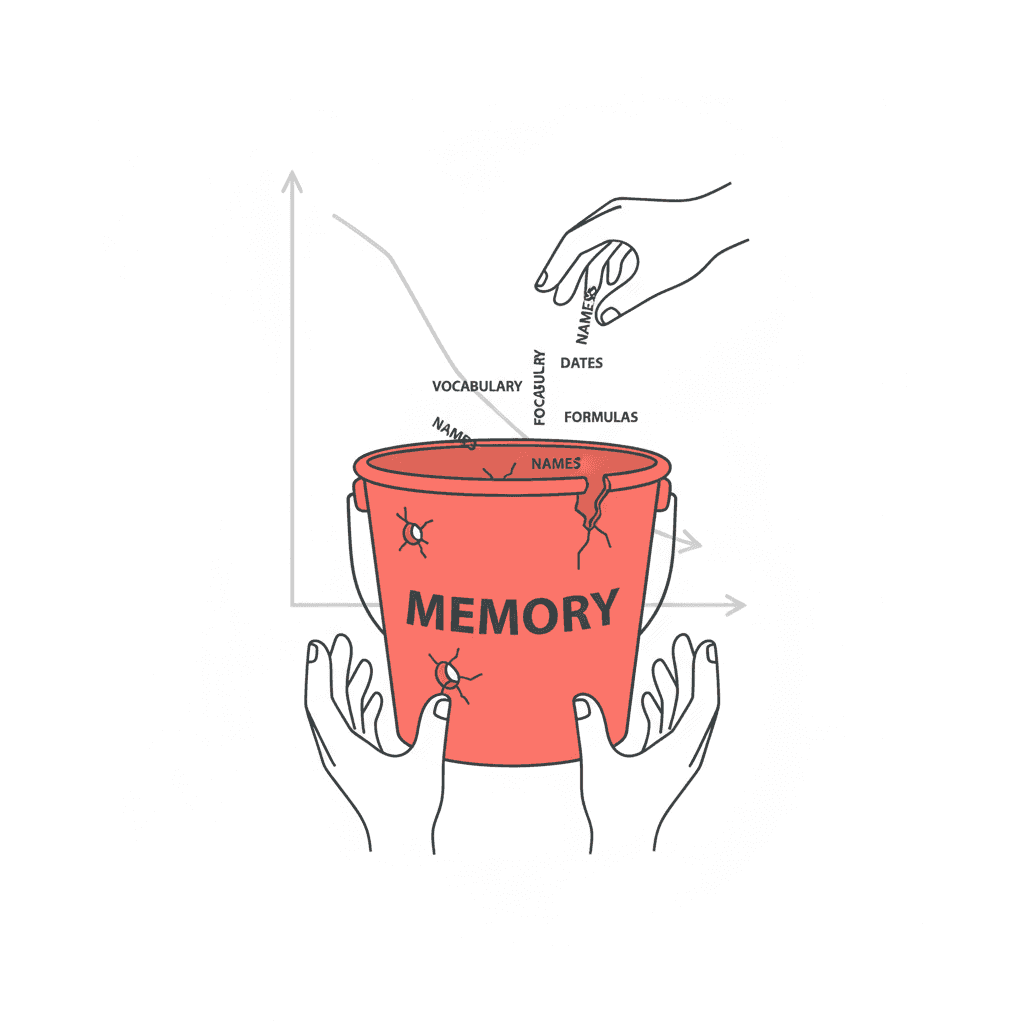
The Frustrating Cycle
You study vocabulary. You feel confident. The next day, the words are gone. You study again. Same result. What's going wrong?
The truth is: nothing is wrong with you. Your brain is working exactly as designed. Understanding why helps you work with your brain, not against it.
The Forgetting Curve
In 1885, psychologist Hermann Ebbinghaus discovered something remarkable: memory decay follows a predictable pattern.
Without review:
- After 1 hour: 50% forgotten
- After 1 day: 70% forgotten
- After 1 week: 90% forgotten
This isn't a flaw—it's a feature. Your brain filters out information that doesn't seem important. The question becomes: how do you signal importance?
5 Reasons You Keep Forgetting
1. You're Cramming
Cramming—studying intensively in one session—feels productive but creates weak memories.
The problem: Information enters short-term memory but never transfers to long-term storage.
The fix: Distribute your study across multiple sessions. Learning 10 words across 5 days beats learning 50 words in one day.
2. You're Learning Passively
Reading a word list, highlighting, re-reading—these feel like studying but create weak memory traces.
The problem: Recognition is easy; recall is hard. Passive methods train recognition, not recall.
The fix: Test yourself. Cover the definition. Try to remember it. The struggle of retrieval strengthens memory.
3. You're Learning in Isolation
Memorizing "negotiate: to discuss to reach an agreement" creates an isolated fact with no connections.
The problem: Isolated information has fewer retrieval pathways. Nothing triggers the memory.
The fix: Learn in context. Use words in sentences. Connect to personal experiences. Build a web of associations.
4. You're Not Reviewing Strategically
Reviewing too soon wastes time. Reviewing too late means starting over. Most people review randomly.
The problem: Without systematic spacing, you either over-review (inefficient) or under-review (forget).
The fix: Use spaced repetition. Review just before you forget—this is the optimal moment for memory strengthening.
5. You're Overwhelmed
Trying to learn 50 words per day leads to superficial processing.
The problem: Your brain has limited daily capacity for new information. Exceeding it means nothing sticks well.
The fix: Learn fewer words, more deeply. 10 words truly learned beats 50 words quickly forgotten.
The Neuroscience of Memory
Understanding how memory works helps you work with it:
Encoding (Learning)
Information enters through your senses. Deeper processing = stronger encoding.
Weak encoding: Reading a word once Strong encoding: Visualizing, speaking, writing, and connecting the word
Consolidation (Storage)
Your brain stabilizes memories over time, especially during sleep.
Implication: Review before sleep. Get adequate rest. Don't pull all-nighters before tests.
Retrieval (Recall)
Each successful recall strengthens the memory pathway.
Implication: Testing yourself > re-reading. Struggle to remember > easy recognition.
The Solution Framework
Step 1: Limit Daily New Words
Recommendation: 5-15 new words per day maximum
More than this overwhelms working memory. Quality over quantity.
Step 2: Encode Deeply
For each new word:
- Read the definition
- See it in an example sentence
- Create your own sentence
- Visualize the meaning
- Say it aloud
- Connect it to something you know
Time investment: 1-2 minutes per word
Step 3: Use Spaced Repetition
Review schedule:
- 1 hour after learning
- 6 hours after learning
- 1 day later
- 2 days later
- 1 week later
Each review should be active recall, not passive reading.
Step 4: Create Retrieval Cues
Build multiple pathways to each word:
- Visual image
- Personal connection
- Sound association
- Physical gesture
- Contextual memory (where you learned it)
More pathways = more chances to retrieve.
Step 5: Sleep on It
Review your day's words before bed. Your brain consolidates during sleep—give it the right material to work with.
Common Questions
"Why can I recognize words but not recall them?"
Recognition and recall use different brain processes. Passive study trains recognition; active recall trains retrieval. You must practice the skill you want to develop.
"Why do I remember some words easily but not others?"
Words connected to emotion, personal experience, or existing knowledge stick better. For difficult words, consciously create these connections.
"Should I write words by hand?"
Research shows handwriting improves retention compared to typing. The motor involvement creates additional memory traces. If time permits, write by hand.
"How long until a word is 'permanent'?"
After 5-7 successful recalls with spaced repetition, words typically enter long-term memory and require only occasional maintenance review.
Your 30-Day Challenge
Week 1: Establish Baseline
- Learn 10 words using your current method
- Test yourself after 3 days
- Note how many you remember
Week 2-4: Apply the Framework
- Limit to 10 words/day
- Use deep encoding (2 minutes per word)
- Follow spaced repetition schedule
- Review before bed
Day 30: Compare
- Test yourself on Week 1 words
- Test yourself on Week 2-4 words
- Notice the difference
Most people see 50-70% improvement in retention.
The Bottom Line
You're not forgetting because something is wrong with you. You're forgetting because you're studying in ways that don't match how memory works.
Change your method. Work with your brain. The words will stick.
Forgetting is the default. Remembering is a skill. And skills can be learned.
Ready to start learning?
Join thousands of learners improving their vocabulary every day.
Get Started Free